Ines Powell · 4 October 2026
Navigating the Effects of Content Delivery Variations on Indexing Timelines in Emerging Web Discovery Platforms
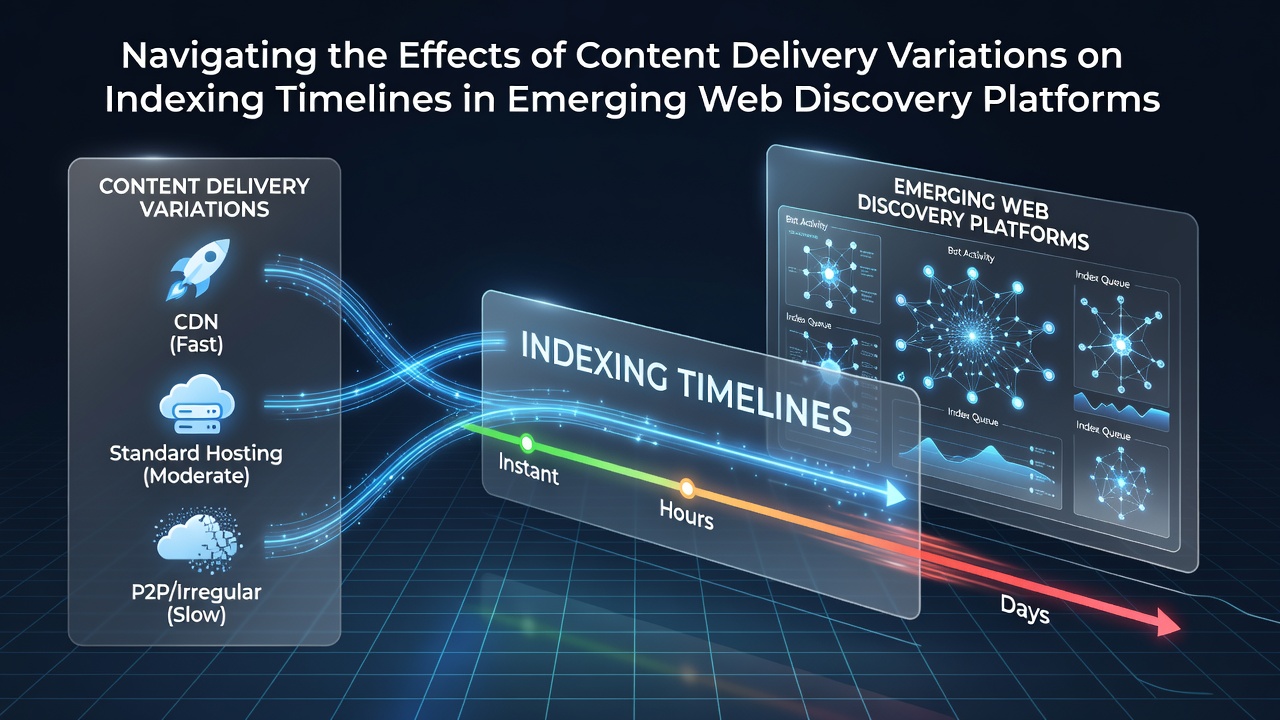
Content delivery variations shape how quickly emerging web discovery platforms process and index new material, and observers note that differences in caching layers, edge server configurations, and protocol choices directly influence crawl frequency and freshness signals. Researchers tracking these systems report that platforms relying on distributed delivery networks often experience staggered indexing windows compared with those using centralized origin servers, because each node introduces its own latency and validation steps before content reaches the discovery layer.
Core Mechanics of Delivery and Discovery
Modern delivery setups route requests through content delivery networks that replicate assets across geographic regions, yet the same replication creates multiple versions that discovery crawlers must reconcile before assigning an index entry. Studies from network engineering groups show that when edge caches serve stale copies, the time between publication and first crawl extends by several hours or days, depending on cache invalidation rules. Emerging platforms that incorporate real-time telemetry feeds attempt to bypass some of these delays by pulling metadata directly from origin servers, but adoption remains uneven across regions.
Regional Infrastructure Differences in October 2026
By October 2026, several discovery platforms operating in the Asia-Pacific region had begun testing protocol-level hints that signal cache freshness to automated agents, while North American and European operators continued to rely on traditional HTTP header directives. Data collected by academic teams at institutions in Canada and Australia indicate that platforms using these hints reduced average indexing latency by measurable margins when content traveled through multi-hop delivery paths. The variations arise because each region maintains distinct peering agreements and regulatory expectations around data residency, which in turn affect how aggressively crawlers can request updated versions.
Protocol and Caching Interactions
HTTP/3 and QUIC implementations alter the sequence in which discovery systems receive header information, and evidence from laboratory tests reveals that these protocols sometimes compress validation steps yet occasionally introduce new handshake overhead that delays the initial fetch. Observers who monitor large-scale deployments note that platforms combining QUIC with aggressive edge caching must balance reduced round-trip times against the risk that cached objects bypass freshness checks entirely. When invalidation signals fail to propagate promptly, entire batches of content remain outside the index until the next scheduled crawl cycle.

Case Patterns Across Platform Types
One research group examined a decentralized discovery network that routes content through peer-to-peer relays rather than conventional CDNs, and their logs showed indexing events clustered around periods of high peer availability rather than publication timestamps. In contrast, platforms built on centralized cloud delivery recorded more consistent timelines when origin servers pushed explicit last-modified values. Figures released by European research consortia tracking these patterns suggest that hybrid models, which combine edge replication with periodic origin verification, produce the narrowest variance in indexing intervals across different content types.
Telemetry and Metadata Signals
Discovery systems increasingly ingest telemetry streams that report cache hit ratios and delivery path lengths, allowing them to prioritize fetches from nodes most likely to hold current versions. According to reports compiled by standards bodies focused on web architecture, platforms that expose these streams to external crawlers shorten the window between content update and index inclusion, provided the signals include accurate timestamps and integrity hashes. Without such coordination, crawlers default to conservative polling intervals that extend timelines regardless of the underlying delivery infrastructure.
Future Adjustments in Platform Design
Engineers working on next-generation discovery tools continue to experiment with predictive prefetching that anticipates delivery variations based on historical node behavior, and early results from pilot programs indicate potential reductions in average indexing lag when models account for regional cache policies. Those programs also track how changes in delivery protocols propagate through the system, because a single protocol update can shift the entire distribution of indexing events across thousands of domains.
Conclusion
Content delivery variations remain a primary variable in determining indexing timelines for emerging web discovery platforms, and the interplay between caching layers, protocol choices, and regional infrastructure continues to produce measurable differences in how quickly new material becomes discoverable. Data from ongoing studies show that platforms able to incorporate freshness signals and telemetry from delivery networks achieve tighter alignment between publication and index inclusion, while those operating without such coordination face extended and less predictable windows. As October 2026 approaches, further refinements in metadata exchange and predictive routing stand to narrow these gaps across geographic and architectural boundaries.